©陶陶居藝廊擁有所有照片的版權, 嚴禁盜用
©Tao Tao Art holding the copyright of all photos. Unauthorized use is strictly prohibited.


關公
九十年代
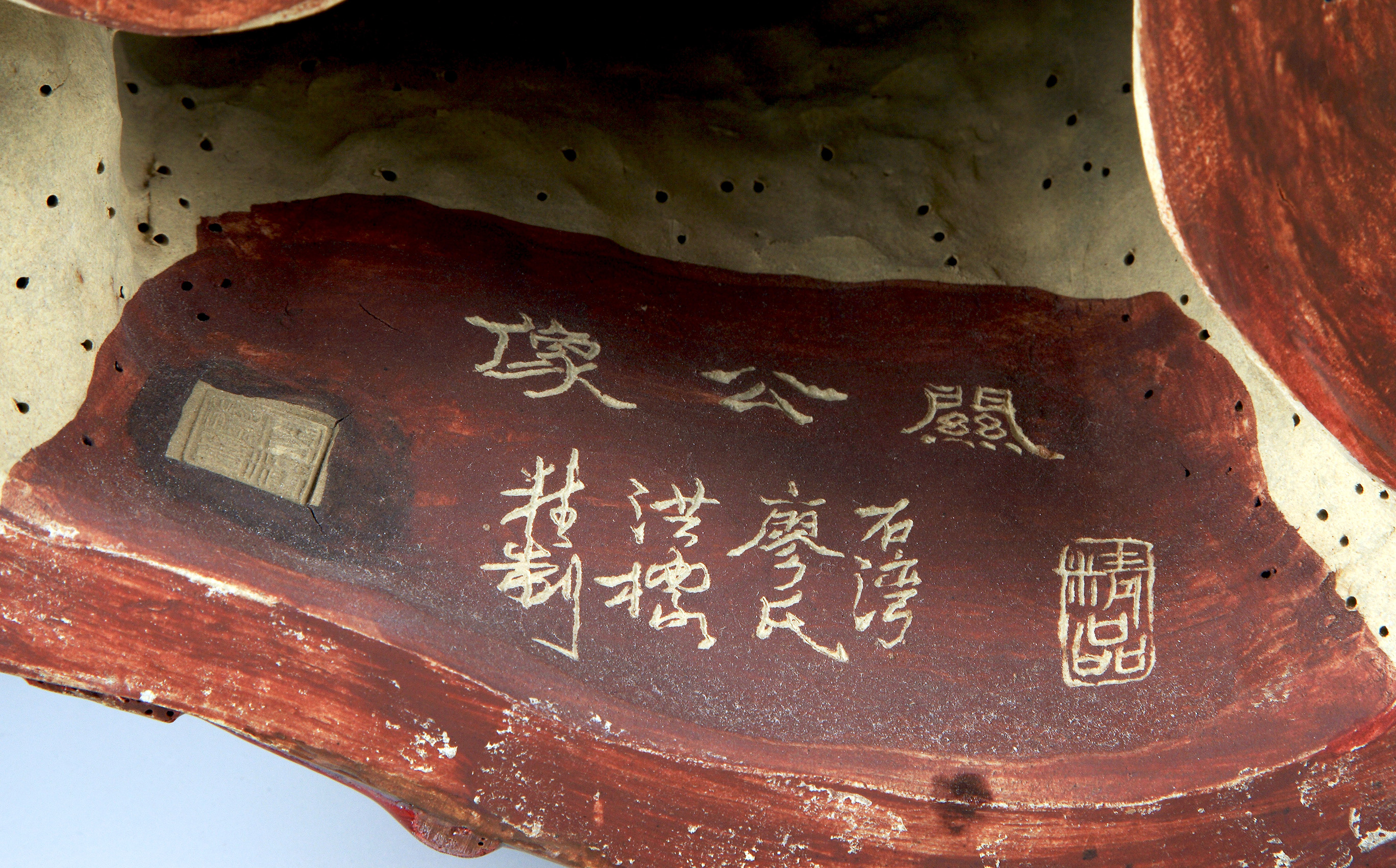
廖洪標精製
26×19×48 cm
General Guan Yu
1990s
made by Liao Hongbiao with extra care
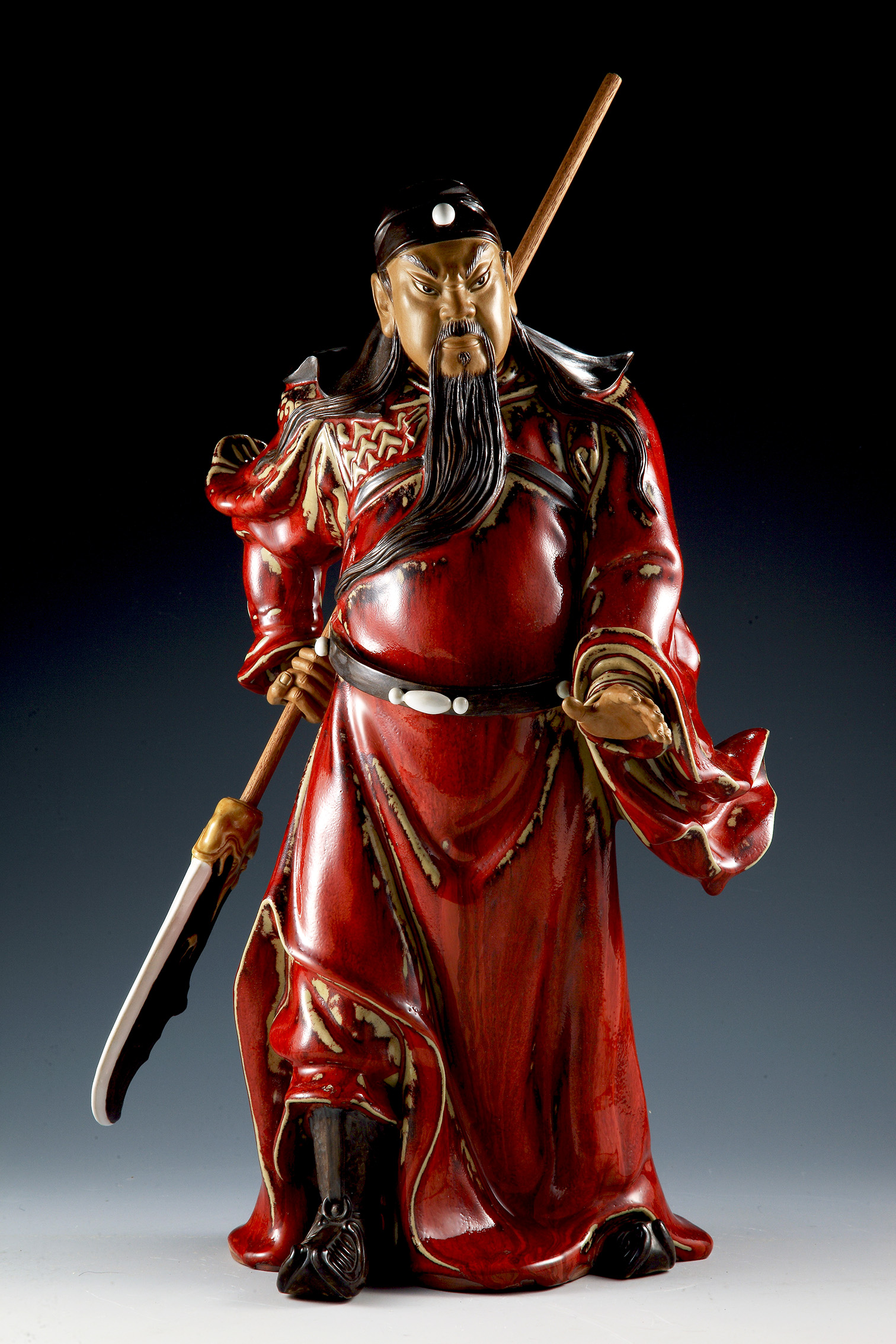
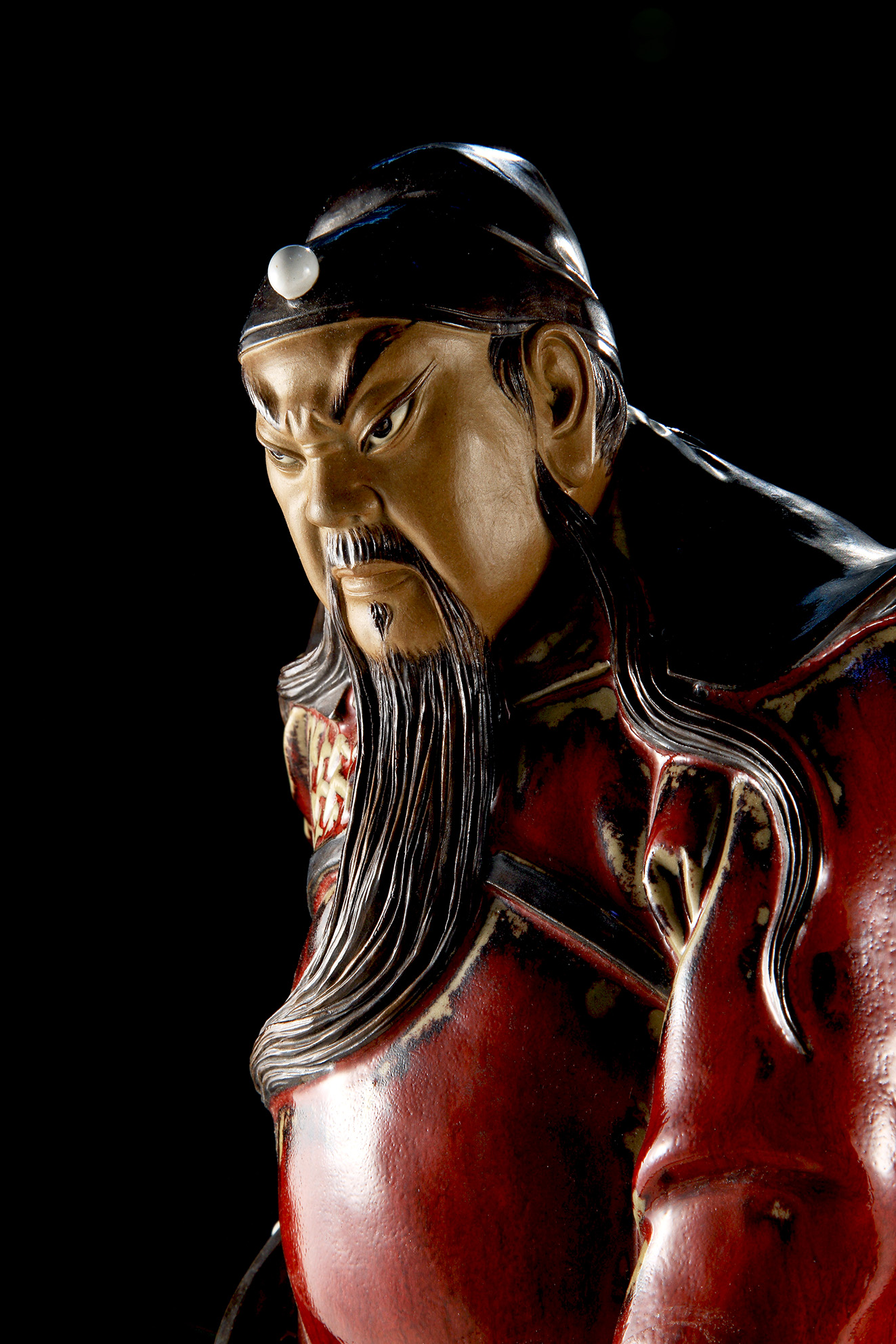
三國蜀漢大將,姓關名羽字雲長,東漢末與劉備、張飛結為異姓兄弟,誓同生死,共扶漢室。是中國封建時代的「忠、義」典範人物。封漢壽亭侯,後受尊「武聖帝君」(註1),他的忠義品格,宋元至今深受民間及海內外華僑尊崇,視為正義化身,作神供奉,尊稱「忠義仁勇關聖帝君」。《三國演義》記載關公的相貌是:身長九尺、鬚長過腹、面如重棗、唇若塗脂、丹鳳眼、臥蠶眉、頭戴綠巾、身穿綠袍、相貌堂堂、威風凜凜。 在中國以關公為題材的雕像甚多,廖洪標被公認為「關公王」。因他所塑的關公氣宇軒昂,威武中兼具儒雅風範及豁達忠誠大將氣概。藉由關羽人體結構的力態美感,表現人物「忠、義、勇」的英雄性格。 十八吋或廿八吋關公立像是描述關羽單刀赴會魯肅的情節(註2),就時間上而言,比五虎將中之關羽更接近東吳。右手提著青龍偃月刀,左手伸出,正準備與對方辯論、一副先禮後兵神態。綠釉作品較合乎小說故事,但中國在文化傳統上較著重紅色,故紅釉關公亦深受喜愛。 本作品關公左手在前展五指於魯肅,右手握青龍偃月刀於身後,鋒刃向後,有武將蓄勢待發之狀。象徵敵若動則我先動,欲奪我欺我,定斬不饒;作品的面部表情眉毛上揚、目光炯炯,雖怒斥周倉,實則是指桑罵槐,暗告魯肅等吳臣不可妄動,欲奪取荊州寶土,先得破此豪情壯志。關雲長八字大開挺立臨江亭,佯稱醉意、酒氣微醺,然其文韜武略了然於胸。此等忠、義、勇豈常人得為之。
Guan Yu, with the style name Guan Yunchang, was a great general of the Kingdom of Shu Han, one of the Three Kingdoms. In the late Eastern Han Dynasty, Liu Bei, Zhang Fei and Guan Yu became sworn brothers and they vowed to live and die together and to serve the Han court. In feudal China, Guan Yu had been regarded as a role model of “loyalty and righteousness”. The title Marquis of Shouting of the Han Dynasty was granted to him, and he was bestowed posthumously the title Wu Sheng Di Jun (Saintly Emperor Guan of War) (See Note 1) A man of loyalty and righteousness, he has been greatly respected by the mass and overseas Chinese since the Song and Yuan era. He is regarded as the personification of righteousness and worshipped as a deity with the title of “Saintly Loyal Righteous Kind and Courageous Emperor Guan”. In the novel Romance of the Three Kingdoms, there is a description of the physical appearance of Guan Yu: a person at a height of nine chi (a traditional Chinese unit of length, approximately equal to one foot), with a long beard hanging over his belly. His face was of the color of a zao (Chinese date) and his lips were so red that they seemed to have been polished by rouge. His eyes were like those of a phoenix’s and his eyebrows resembled silkworms. He was wearing a green head cloth and a green robe. He had a dignified aura and looked quite majestic. There are countless statues of Guan Yu in China. Liao Hongbiao is recognized as the “King of Guan Yu”, because his works of Guan Yu have a particularly imposing appearance – looking powerful, Guan Yu is not only a magnanimous and loyal general but also embraces scholarly temperament. Liao is apt at making use of the beauty of the strength of Guan Yu’s body structure to present the hero’s qualities of “loyalty, righteousness and courage”. This standing statue of Guan Yu of 18 inches by 28 inches in dimensions depicts the episode of the general attending single-handed the banquet hosted by Lu Su. (See Note 2). This is an episode in which Guan gets closer to Eastern Wu, another kingdom of the Three Kingdoms, and it goes on the stage earlier than the one where Guan becomes one of the Five Tiger Generals. Guan is holding his weapon, the Green Dragon Crescent Blade, in his right hand, and showing his left hand. He is about to start a debate with his opponent and he wants to try fair means before resorting to force. The Green Glaze matches the description of Guan in the novel, but more importance has been attached to the red colour in Chinese cultural tradition. This is why red-glaze statues of Guan Yu have been much adored. Green Dragon Crescent Blade in his right hand at his back. With the blade facing backward, he is a warrior in a poise from which he is ready to resort to force at any moment. The implications are easy to understand – if my opponent takes any action, I’ll move faster than him; if his tries to strike me or rob anything from me, I’ll cut him into two pieces without hesitation. With rising eyebrows and bright piercing eyes, Guan reviles Zhou Cang angrily but he is actually striking at Lu Su and his colleagues. He insinuates that the Eastern Wu officials including Lu Su should not commit any rash acts – if they want to take forcible possession of Jing Zhou, a place of great strategic value, they should first destroy him, a man of lofty sentiments and high aspirations. With his toes pointing outwards, Guan stands upright in the Linjiang Pavilion (the pavilion by the bank of the Yangtze River). Pretending that he is drunk, he is using his wisdom and ready to resort to his martial talents to handle the difficult situation. Only great heroes have such qualities of loyalty, righteousness and courage.
 HOME
HOME